Noises in The Loft
You're lying in bed and you can hear something moving above your head. Scratching, scurrying, maybe a thud or a faint gnawing sound. It stops. Then it starts again.
Noises in the attic are one of the most common reasons people call us.
The good news is that the type of sound you’re hearing, and when you hear it, usually tells us a lot about what’s up there before we even visit.
Here is everything you need to know about noises in the loft, including what species it may be caused by.
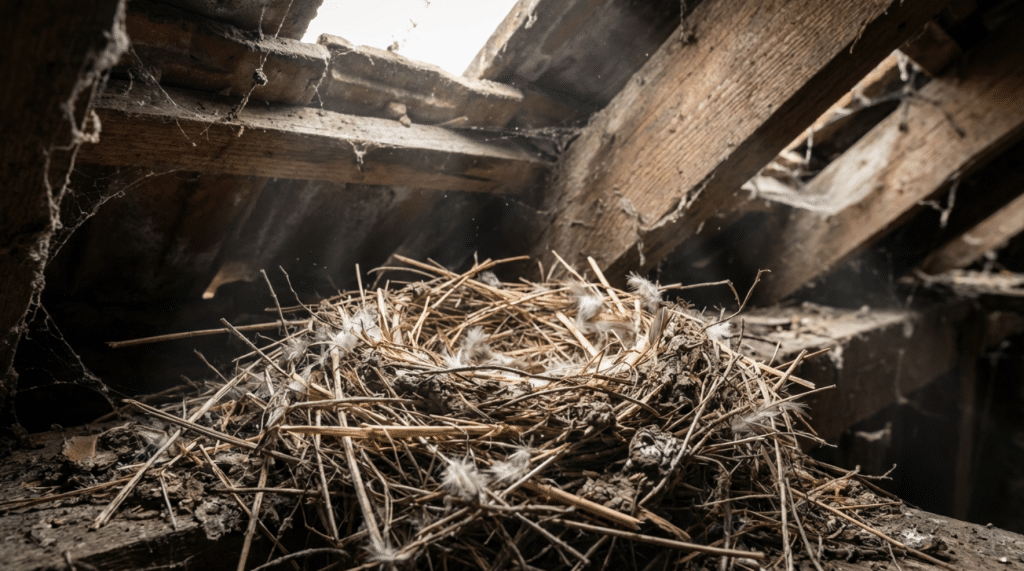

How to know what sort of pest problem you are experiencing?
It can be handy to know what type of pests have found their way into your home.
Make a note of the time they are active, as well as if you are experiencing a constant noise.
Don’t worry if you are struggling to work it out! Our trusted team offer free site surveys where we can investigate your problem and tailor our support to your home or business.
Time of day is your first clue
This is the single most useful piece of information when working out what’s in your loft.
Different pests are active at different times, and that narrows things down quickly.
Noises at night
If the noises are heard typically after dark and into the early hours it usually point to rats, mice, or bats.
These are all nocturnal, so if you’re hearing activity while you’re trying to sleep, one of these three is the most likely cause.
Noises during the day
Are your noises happening in the early morning or late afternoon? It is most likely squirrels or birds.
Both are active during daylight and tend to quieten down once it gets dark.
Constant noise
Noise that doesn’t seem to follow a pattern could be a wasp or bee nest.
A low, steady buzzing from the loft space, particularly in warmer months, is worth investigating.

Contact Clark Pest Control Today
If you are dealing with a pest population that has found their way into you attic, it is important you get the trusted help you need to effectively handle the problem. Clark Pest Control offers rapid support and effective solutions to a wide range of pest problems.
For more information call us today on 0800 808 5615.
The common culprits
Some of the most common pest problems within attics include:
- Rats
- Mice
- Squirrels
- Birds
- Bats
- Wasps and bees
Rats
Rats are the pest most people are worried about, and they’re one of the most common pests that we find in loft spaces across Scotland and Northern England. Your loft offers warmth, shelter and ideal nesting materials, all within easy reach of food sources such as your kitchen or outdoor bins.
What rats sound like
Heavy scurrying and scratching, often across the full length of the loft. Rats are bigger than mice, so the footsteps sound heavier and more deliberate. Rats are also highly social animals, so you may hear them chasing one another, play fighting and scuffling above you.
You’ll also hear gnawing, which can be surprisingly loud as they chew through wood, plastic, and even electrical cables.
What time your will hear them
Rats are nocturnal, so they become active after dark and tend to go quiet during the day. If you’re hearing heavy movement between around 10pm and 4am, rats are high on the list.
Other warning signs to look out for
Dark, pellet-shaped droppings (about the size of a large grain of rice), greasy smear marks along beams and walls where they follow the same routes, and a strong, musty smell. Check for gnaw marks on wiring, pipes, and stored items.

Mice
Mice are smaller and quieter than rats, but they’re just as common in UK lofts and can cause similar problems.
Sounds mice make
Mice are smaller and quieter than rats, even during their active hours. You may hear a light scratching, soft scurrying, and a faint pitter-patter from their lighter footfalls.
You might also hear quiet nibbling or rustling as they move through insulation.
When you hear mice
Mainly at night, though mice can be active during the day in quiet properties.
If the scratching sounds light and fast rather than heavy and deliberate, it’s more likely mice than rats.
Other signs mice are present
Tiny, dark droppings (smaller than a grain of rice), shredded insulation or cardboard used for nesting, and small entry holes all point to mouse activity.
Mice can squeeze through gaps as small as a pencil width, so even well-sealed lofts aren’t immune.
Squirrels
Grey squirrels are active during the day, which makes them easier to distinguish from rats and mice by timing alone.
What squirrels sound like
Loud, frantic scurrying and scratching.
Squirrels are surprisingly noisy for their size because they move fast and tend to leap and bound rather than creep. You might also hear rolling or tapping sounds as they move nuts or other cached food around your attic.
When you hear squirrels
Squirrels are most active in the early morning (shortly after dawn) and late afternoon (before dusk).
If the house goes quiet at night but comes alive at first light, squirrels are the most likely cause.
Other signs of squirrel activity
Squirrel droppings are usually larger than mouse droppings and tend to be rounder in shape. The good news is that squirrels will usually remain in the loft once they have gained access to your home, so any droppings are often limited to that area.
Due to their nesting behaviour, you may find torn-up insulation, and chewed entry points that are typically around 5-7cm wide.
Squirrels chew to maintain their teeth, so damage to roof timbers, fascia boards, and stored items is common.
Birds
Birds nesting in loft spaces are common, particularly in spring and early summer when they’re looking for sheltered spots to raise chicks.
Typical bird activity noises
Flapping, chirping, tweeting, and cooing, are clear signs of bird activity.
Pigeons in particular produce a low, repetitive cooing sound that carries through ceilings. Starlings are louder and more chaotic.
Time birds are most active
Birds are usually active at daytime, especially dawn and dusk.
Nesting birds are most vocal in the early morning, when they are waiting to be fed by their parents. If you find you being woken at 4am by chirping from above, birds are the most likely culprit.
Other signs of bird activity
Droppings near entry points on the outside of the building, feathers, and visible nesting material around eaves, soffits, or gaps in the roofline. You may also notice an increase in flies or mites, which are attracted to bird nests.
Bats
Bats in the loft are more common than people realise, particularly in older properties and rural areas. They’re also the one pest on this list where you need to be very careful about what you do next.
If you suspect you have bats in your attic, do not go up to inspect or attempt to remove bats yourself.
All bat species in the UK are protected under the Wildlife and Countryside Act 1981 and the Conservation of Habitats and Species Regulations 2017. It’s illegal to disturb, capture, or harm bats, or to block access to a known roost.
If you suspect bats, do not attempt to seal entry points or remove them yourself. Call us and we’ll advise on the correct approach.
What bats sounds like
Bats are small and light, so the noises are subtle. But very faint scratching or shuffling, and occasional high-pitched squeaking or chittering can be a sign of bats.
You’re more likely to notice them at dusk when they leave the roost, as you might hear brief fluttering near the eaves.
When you hear their noises
You may hear bat activity at dusk and dawn, when they enter and leave the roost.
Bat activity in lofts tends to be seasonal, peaking in summer when maternity colonies form.
Other signs of bats
Small, dark droppings that crumble to dust when pressed (unlike mouse droppings, which are hard). You may also notice staining around entry points and a faint, musky smell.
Wasps and bees
A wasp nest in the loft space produces a low, steady buzzing that you might hear through the ceiling. It tends to be constant rather than intermittent, and it gets louder as the nest grows through the summer months.
Bees can also nest in loft spaces, particularly masonry bees and bumblebees. The sound is similar to wasps but often lower-pitched. Honeybee colonies in a loft can become very large and may need specialist removal.
If you’re hearing buzzing from the loft between May and September, it’s worth getting it checked.
Wasp nests grow quickly, and a nest that’s small in June can be the size of a football by August.

What not to do when dealing with a loft infestation
Don’t attempt to poison or trap anything in your loft without knowing what you’re dealing with.
Using the wrong bait or traps can be ineffective, inhumane, or illegal depending on the species.
Don’t block up entry holes before the pest has been removed. You’ll trap whatever is inside, which usually makes the problem worse. Trapped rats and squirrels will cause far more damage trying to get out.
And if there’s any chance it could be bats, don’t touch anything. Call a professional first.

Contact Clark Pest Control
If you’re hearing noises in your loft and you’re not sure what’s causing them, that’s exactly what our pest control experts are here for.
Our technicians can identify the pest, assess the extent of the problem, and recommend the right treatment.
We cover Glasgow, Edinburgh, Aberdeen, Newcastle, Sunderland, and County Durham, with same-day response available across all our branches.
Call us on 0800 808 5615 for a free survey, or get in touch through our website. We’re available 24/7.