
How to Get Rid of Pigeons
Pigeons have become one of Scotland’s most prominent pest species, moving into urban areas in the search for food and shelter.
Pigeons will gather in large numbers, known as roosting, on rooftops, inside warehouses, on the sides of buildings, and pretty much anywhere else that is close to an easily accessible food source.
Unfortunately, despite their attractive appearance, pigeons can do huge amounts of damage when gathering in large numbers, spreading disease, damaging property, and creating a fire risk by building nests inside buildings.
A pigeon infestation can also do significant damage to your quality of life making a tremendous amount of noise and producing a large amount of faeces that can ruin the aesthetic of even the most beautiful of properties.
If you are dealing with pigeon problems of any kind, Clark Pest Control are here to help with BPCA accredited technicians highly trained to implement a huge range of pigeon proofing and pigeon removal services from bird netting to trapping and falconry.
This guide will give you all the information that you need to identify a pigeon infestation, how to pigeon proof your property, and all the professional services that we offer to get rid of a pigeon infestation and make sure that it NEVER returns.
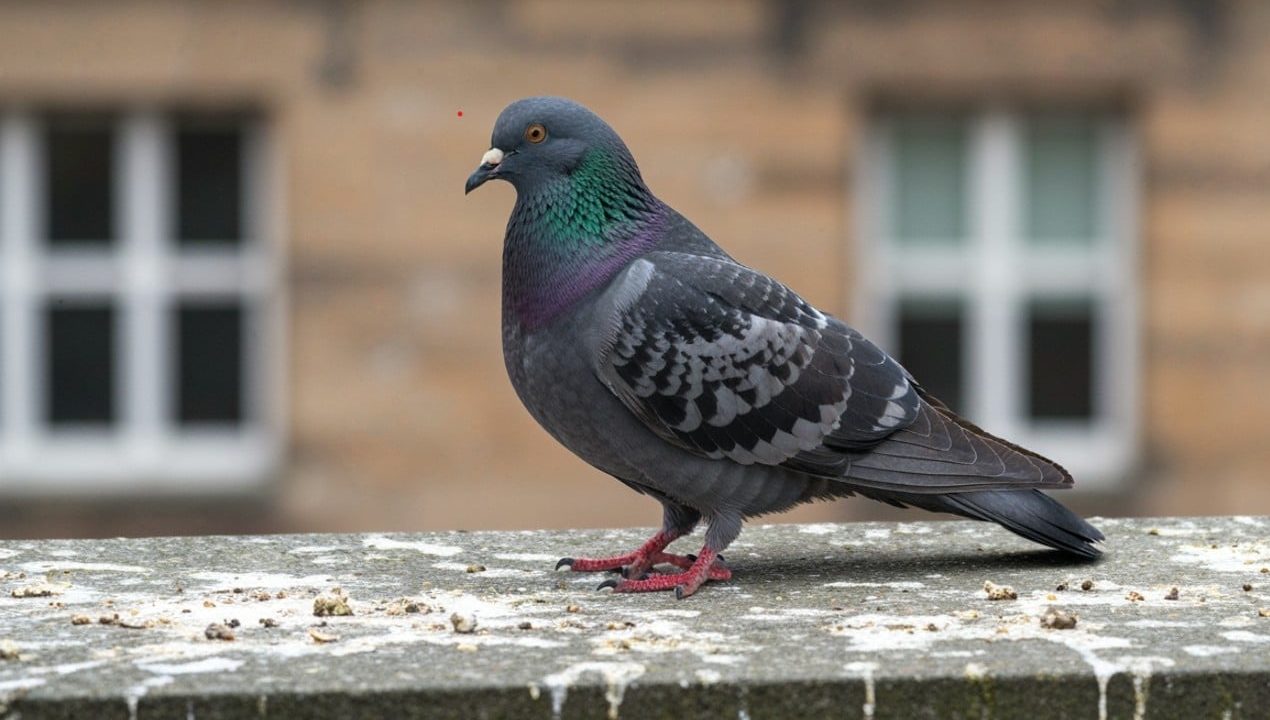
Feral Pigeons (Columba Livia)
Feral pigeons (Columba Livia), also known as rock doves, are a species of bird that are considered as pests in the UK due to their tendency to roost inside, and on the exterior of, human inhabited buildings.
Appearance
Adult feral pigeons are around 30cm in length and weigh anywhere from 250-550g.
They are usually a grey-blue colour with a purple tint in the neck area but can also vary tremendously in appearance with colouring ranging from almost black to pure white.
There is no obvious visual difference between male and female feral pigeons.
Diet
Pretty much anything they can find.
The traditional diet of most pigeon species is a balanced combination of seeds, protein, and fruits but feral pigeons aren’t that picky.
If humans eat it, feral pigeons will give in ago and populations in urban areas thrive on food thrown into the garbage or left on the ground.
Pigeons do need a water source and will, therefore, often be seen close to fountains, streams, and bird baths in domestic gardens.
Activity
Left to their own devices, feral pigeons will quickly take over urban areas, breeding rapidly and finding their way into loft spaces, abandoned buildings, and anywhere else that offers shelter in close proximity to food.
Pigeons nest in all these areas and more and an infestation can be found pretty much anywhere in Scotland.
They will live for around 3-6 years, far shorter than a pet pigeon or those in rural or semi-rural areas.
During this time, however, they will breed rapidly, reaching sexual maturity after just 6 months and produce as many as 7 broods of 1-3 chicks every single year.
It is no wonder, then, that these dirty birds can overrun properties in both urban and rural areas and that pest control companies spend a large proportion of their time dealing with infestations.
Other pest birds
Pigeons are not the only birds that can cause pest control issues in Scotland.
Here at Clark, we also provide bird proofing and removal services to deal with problems involving the following species:
- Gulls (Laridae)
- Starlings (Sturnus vulgaris)
- House Sparrows (Passer domesticus)
- Canada Geese (Branta canadensis)
IMPORTANT – All birds are protected under Animal Welfare legislation and there are very strict rules around what action can be taken even against the most common pest bird species.
For this reason, among many more, it is always best to use a BPCA professional when dealing with pest infestations and never attempt DIY bird removal.
Why do pigeons live in urban areas?
Pigeons have lived alongside humans in towns and cities across the UK for centuries but what is it that is so attractive about living on your property and close to humans in general?
Well, urban areas are heavily populated by humans for good reason, and many of these reasons also apply to pigeons.
There is plenty of shelter, a constant abundant supply of food, and a large population of their fellows for interaction and to help find a mate.
The fact is that pigeon populations have only grown to such a large size due to their close relationship with humans.
Everything that a pigeon could possibly need can be found in urban areas and whilst this may seem like a negative if it is your property that these pests have chosen to roost on it can also be used to your advantage.
With so many food and shelter options available, there is no reason for pigeons to hang around a property where they feel threatened or unwelcome, meaning that a few pigeon proofing measures are often enough to convince them to move elsewhere.
Why are pigeons a problem?
If you live in an urban area, pigeons are a normal part of day-to-day life.
Many people believe that apart from lurking nearby whilst you are eating your lunchtime sandwich, pigeons are pretty harmless.
This is untrue. The fact is that pigeons can cause all sorts of serious problems in urban areas, spreading disease, damaging property, and generally creating an unsafe and unhygienic environment to live and work in.
Here’s a guide to just some of the damage that a pigeon infestation can do and why they are considered such a significant health and safety hazard.
Disease Spreading
Pigeons are some of the most prolific disease spreaders of any pest species in the UK.
Feral pigeons can carry as many as 60 different pathogens at a single time, and around half carry diseases that can result in serious, or even life-threatening, health problems when transmitted to humans.
Not only do the birds themselves carry diseases that can be spread in a number of different ways, but can also host a number of parasites that spread their own diseases.
Methods of disease transmission from pigeons to humans include:
- Direct contact with birds themselves (Uncommon)
- Contact with or accidental consumption of bird faeces.
- Inhalation of contaminated particles of droppings that have dried out turned to dust, and become airborne.
Diseases spread by pigeons
There are a huge number of diseases spread by pigeons varying widely in severity and prevalence.
Some of the most common diseases spread that can be harmful to humans include:
Psittacosis
Caused through the transmission of the bacterium C. Psittaci, psittacosis is a highly infectious infection spread almost exclusively by birds.
In humans, psittacosis presents itself as a fever, breathing difficulties, chills, muscle pain, and a dry cough. In more serious cases, the individual may also cough up some blood.
Normally, symptoms will subside after around a week but in rare cases, it can lead to extremely serious respiratory complications or an inflammation of brain tissue that causes permanent brain damage.
E. Coli and Salmonella
More well-known than many other diseases on this list due to their close relationship to food poisoning, E. Coli and Salmonella are also spread by pest birds.
In general, E. Coli and Salmonella can be fought off by the human body in less than a week although kidney issues are possible in extreme situations.
Symptoms include nausea, stomach pain, diarrhoea, and fatigue.
Histoplasmosis
A respiratory condition that is caused by fungus growing in pigeon droppings.
Symptoms similar to that of the flu or common cold, including a cough, headaches, fever, and fatigue.
Symptoms can be worse for those with an existing respiratory issue but will usually resolve themselves within a couple of weeks.
Corrosion
Pigeons can damage buildings in a number of different ways, costing property owners across Scotland thousands of pounds every single year.
Firstly, pigeon feces is incredibly acidic in its composition and, over time, will cause stone, brick, and even metal to corrode.
If you are dealing with a large bird infestation, the layer of droppings will grow at a rapid rate, as will the speed of erosion and the cost of the repairs required.
Without action, an infestation of pigeons or other birds of a similar nature will do serious, potentially fatal, damage to the structure of your property.
Slip Hazard
The risk of slips and falls on surfaces covered in pigeon droppings is high.
This is not only because the faeces itself makes walkways slippery but also because as surfaces erode, steps and paths become uneven and treacherous to the unwary visitor.
For businesses, there is a serious risk of public liability should a visitor or customer injure themselves as a result of this, and if you were aware of the issue but failed to take the appropriate action, there is a good chance that your insurance will be invalid.
If possible, close off any walkways or stairwells that have been affected by a pigeon infestation until the issue has been resolved via professional pest control.
Water Damage
Another issue caused by the surface erosion effect of pigeon faeces is that it can expose the inside of your property to the elements, leading to leaks that can do significant damage to property.
Pigeon nests also often block gutters and drainpipes, causing water to build up and sending the risk of burst pipes and leaks even higher.
Besides the direct damage that water can do to electrical appliances, paperwork, and other valuable items within your property, it also raises the risk of fire when in contact with live electrical wiring and can lead to mould and mildew growth.
Fire Hazard
Pigeons will make their nests from pretty much any materials that they can find, many of which are highly flammable.
They will also build them pretty much anywhere, including inside chimney chutes.
Should a fire be lit below them, there is a significantly increased risk of fire and of poisonous gases being trapped inside the building.
Pigeon nests are also frequently found next to electrical equipment and can cause appliances to overheat, posing a fire risk and putting those nearby in danger.
Reputation
No matter how stylish and elegant your property may be, it’s not going to look its best when covered in pigeon droppings.
There is no way around it, pigeon dropping covered buildings and walkways look and smell disgusting, and will significantly damage the reputation of your property and the surrounding area.
Whether you run a business and are looking to impress customers and partners, or are simply welcoming friends or family round to your home, a pigeon problem will make it impossible to appear at your best.
In commercial settings, a pigeon population can have a tangible effect on your business as an unhygienic premises can ruin your reputation and make it much harder to secure and retain customers.
Noise
An infestation of feral pigeons is not quiet, and the incessant cooing that comes as part of having them as neighbours can quickly become too much to bear.
The psychological impact of living with a pest infestation is often overlooked but constantly being kept awake at night by the noise of pigeons and the embarrassment of having your property covered in bird mess can take a serious toll on your mental health.
Pigeon Control Services
At Clark Pest Control, we provide leading pigeon removal and proofing services to domestic and commercial customers across Scotland.
We have a huge selection of different bird control technologies and techniques suitable for both residential and commercial properties that have been proven to be highly effective in keeping pigeons away from any property on a permanent basis.
When you choose Clark for your pest bird solutions a highly qualified BPCA accredited pest control specialist will do a full survey of your site, using their expert eye to analyse the situation, identify the most appropriate course of action, and implement the chosen solution.
Our pigeon control services include:
Bird Spikes
Bird spikes are one of the very best ways to pigeon proof your property, simply making it impossible for larger birds to land in common roosting areas.
Pigeon spikes come in flexible stripes with a polycarbonate base that can be attached to almost any surface.
The spikes themselves are made from either polycarbonate or stainless steel and when placed close together make it impossible for pigeons or other birds to land nearby.
They are particularly useful for hard to access, awkward locations where other bird proofing measures cannot be installed such as window sills, balconies, signs, chimneys, drainpipes, and rooflines.
It may surprise you to know that bird spikes are actually a very humane method of bird control and will not kill or seriously harm pigeons in any way.
This is crucial as it is actually illegal to harm birds in any way whilst pigeon proofing your property.
Despite their rather brutal name, these anti roosting ‘spikes’ are actually blunt and are recommended by the RSPB as a humane way to tackle overpopulations of pest birds.
If a pigeon does attempt to land on the surface, they will get simply get a small nudge and be forced to take off once more.
Bird Netting
Bird netting is probably the most comprehensive and effective bird proofing measure it is possible to install.
Netting installation is the only surefire way to prevent pigeons from being able to go where you don’t want them to on your property.
Our netting is highly customisable and comes in a range of different colours, shapes, and materials to suit the needs of all.
Pigeon netting can be used to keep these pesky birds from causing problems anywhere from a massive commercial warehouse or office block, all the way to a single allotment in a domestic garden.
You won’t have to worry about your netting being unsightly or blocking out the sunlight either, as we use the very latest UV stabilised technology to ensure that as much light as possible reaches the property below, whilst protecting staff and visitors by eliminating harmful UV rays.
Lasting upwards of 10 years in some cases, bird netting is a fantastic investment to make, helping to keep nesting pigeons away from your property for good and allowing you to get on with your life and work in peace.
Bird Trapping
If there is an established large population of pigeons nesting on your property it may not be possible to get rid of them through exclusion alone.
Often, an existing infestation must be removed before netting or spikes can be installed.
Trapping is one method of doing this and is certainly an effective way to get rid of pigeons, removing a large number of birds in a short period of time.
Here at Clark, we only ever use traps that have been fully authorised under government standards, provide trapped birds all the food and water needed, and will check the traps at least once every 12 hours to prevent unnecessary distress.
It is essential to note that only qualified licensed pest controllers should attempt to trap or remove birds from a property as there are strict legal consequences for the mishandling of birds in the UK.
Trapping is most effective once birds have become accustomed to them and are no longer afraid to enter them in search of the food sources within.
For this reason, we will leave our traps in place for a certain time before activating them in order to trap pigeons in the largest possible numbers.
A standard bird trapping process takes around 6-8 weeks.
Bird Shooting
Shooting is never the ideal solution to a bird infestation but occasionally there is no choice to effectively control pigeon infestations.
Pigeons breed extremely quickly and a population can soon grow out of control so shooting is required more often with this species than any other pest bird in the UK.
In the past, pigeon shooting would have been carried out using a shotgun but this practice has declined in recent years due to safety concerns and the fact that each shot is far too loud to deal with a large population.
Instead, any shooting we carry out will be conducted by highly trained marksmen using air rifles for maximum accuracy and discretion.
Shooting will only ever be used following a full (Free) survey of your site, after which our expert surveyors will help create the most efficient plan possible to help get rid of pigeons.
Falconry
There is no more effective way to scare pigeons away from your property than to have a falcon, hawk or other bird of prey fly over the roof.
You may have seen this technique used at major sporting events such as Wimbledon using a Harris Hawk, to keep the area pest bird free.
This may seem like quite a holistic and old-fashioned approach to pest control but the fact is that nothing will deter pigeons or other pest birds from nesting in an area like the presence of an unmistakable predator species.
It is not just pigeons that will be deterred by the presence of a bird of prey either, and smaller birds such as starlings that can also pose pest control issues will also make a swift exit from your premises following this practice.
Despite using the threat of danger to remove pigeons in this method, falconry does not harm the target species as it is conducted using birds trained specifically not to harm them.
How to get rid of pigeons at home
If you have a major pigeon problem it is always recommended that you hire professional pest control to resolve the issue.
However, if you are simply looking to keep pigeons away from your garden at home or stop them from returning if you have recently had an infestation removed, there are several effective ways to discourage pigeons from choosing your property as a nesting location.
Here are some of the best DIY ways to stop pigeons at home:
Ultrasound devices
Like many bird species, pigeons have an excellent sense of hearing and are able to detect sound at frequencies that humans cannot.
This comes in handy when searching for food sources, mates, and alerting each other to potential predators, but can also be used against them.
Ultrasound emitting devices can help deter pigeons from venturing too near your property by mimicking the sounds of either a predator or the warning call of another bird.
The higher up you are able to install such a device the better, as it will be more likely to be mistaken for sounds made by bird activity.
Decoy Predators
If there is one thing that pigeons hate most it is the sight of a domineering bird species in close proximity.
Predator species such as hawks and raptors will scare pigeons away in no time which is why falconry is so effective for eradicating infestations.
Unfortunately, this is only possible on rare occasions, usually on rural properties and large estates.
Instead, consider buying a lifelike replica of an owl or similar in your garden.
A stationary model alone may be effective initially but birds will quickly become used to its presence and dismiss it as a threat.
Instead consider either decoy kites, which fly around and mimic the movements of the real bird or a solar powered figurine that moves its head to add an additional level of realism.
Eliminate food sources
No bird deterrent in the world will be strong enough to get rid of pigeons if the attraction of your property is strong enough.
One of the main reasons that pigeons choose to roost near domestic properties is the easy access to food.
There is no shortage of options in most urban areas so a few changes should be enough to convince them that there are better pickings elsewhere.
Ensure that all your rubbish bins are securely shut and that any bird feeders are designed to feel small birds only and cannot be accessed by pigeons or gulls.
With so much food on offer in urban areas, the last thing you want to do is to feed pigeons by accident in your own home.
Bird repellent gel
Another good way to make the roof of your home a less attractive spot for pigeons to roost is to apply bird repellent gel to any surface that you have seen activity.
Ever sat down on a sticky chair before? If so you probably didn’t stay there long, and pigeons aren’t too keen on the sensation either.
This non-toxic gel will keep an area sticky for several weeks, even in adverse weather.
The moment that a pigeon lands there and realises that the surface is sticky they will take off again.
Be careful, however, not to apply too much gel as this can cause birds to get stuck and you could end up in breach of animal welfare regulations.
Bird Shock Tape
Bird shock tape works in a very similar manner to repellent gel but instead of making a surface sticky will deliver a small shock to birds that attempt to land there.
If they do decide to land on the tape, you will see pigeons leave rather quickly from your property, and they won’t be too keen on returning anytime soon.
Shiny objects
You may have heard that magpies are attracted to shiny objects but the same cannot be said of pigeons.
Reflective surfaces and anything else that create bright flashes of lights are generally good bird deterrents.
It is possible to purchase reflective bird deterrents but there really is little need as you can create one just as effective using only what you have around the home.
Old CDs, broken and hung up mobile style on a piece of string, for example, will blow round in the wind and reflect sunlight towards the sky.
Commercial Pigeon Control
Every year in the UK, commercial premises up and down the country require professional pest control services to deal with infestations of pest birds.
An infestation of pigeons on your commercial premises can create an unsafe environment for workers and customers and do significant damage to your reputation.
The cost of repairs, maintenance, and cleaning that comes as a result of having a pigeon infestation on site can be huge.
Not to mention, that should an accident occur as a result of a slippery surface or eroded walkway you could find yourself in legal difficulties that bring their own range of potentially massive costs.
Luckily, here at Clark, we have all the experience and resources needed to tackle your commercial bird problem once and for all.
We understand that you want your pigeon removal to impact your business as little as possible so we offer out of hours and discreet services that will never get in the way of your daily operations.
Each and every service we provide from bird netting and spikes to falconry and shooting will be customer driven, with a bespoke plan developed to meet the needs of the specific business in question.
To ensure a rapid response to any future pest problems and that your site is regularly analysed to minimise the risk of any future issues arising it is recommended that all businesses have an ongoing contract with a professional pest control specialist.
They will not only be on hand should you need them at any time, but will also conduct several routine visits throughout the year to make sure your site is pest free and any deterrents previously installed are still effective and in good working order.
Get in Touch
If you are dealing with a problem involving feral pigeons or pest birds of any kind, Clark Pest Control are the experts that you need to call.
We know that there is no one size fits all solution to bird control problems and work closely with each and every client to design a bespoke solution specifically for their property.
We are based in Edinburgh but provide pest control services across the whole of Scotland, with no property too big, small, or remote for us to handle.
We put customer satisfaction first at all times and will work extremely hard to have your property pigeon free in no time.
For more information on any of the pest bird control services that we provide, or to arrange for a survey of your property, get in touch with our expert team now on 0141 280 0339.
Why Choose Clark Pest Control?
- 24/7 Same Day Response
- Local Branches Across the UK
- State of the Art Equipment
- Fully Insured Pest Control Service
- British Pest Control Association (BPCA)
- Accredited Pest Technicians
- Cost-Effective.
Book a FREE Survey
Call us on 0800 808 5615